
What WVDCR Records Cover
West Virginia's corrections agency goes by the name Division of Corrections and Rehabilitation, or WVDCR. Its Offender Search hub points to four distinct tools. Each one answers a different question. Daily Incarcerations shows admissions as they happen. The jail search covers the regional-jail layer, while the prison search handles state-prison offenders. The fourth route lists escapees and absconders. A WVDCR entry belongs to the tool that produced it. Check that label. It shows where a person stands before you draw conclusions.
The split matters when someone wants a West Virginia mugshot. A local arrest can land a person in a regional jail after transport. A prison sentence moves the record into a different layer. An arrest before admission may not show up in WVDCR at all. Municipal holding, juvenile matters, and federal custody sit outside this system. So do sealed files and local police reports. WVDCR is the authoritative statewide path for its own custody and offender records. It is not a complete index of every arrest in the state. The agency's landing page shows how these tools are kept separate.
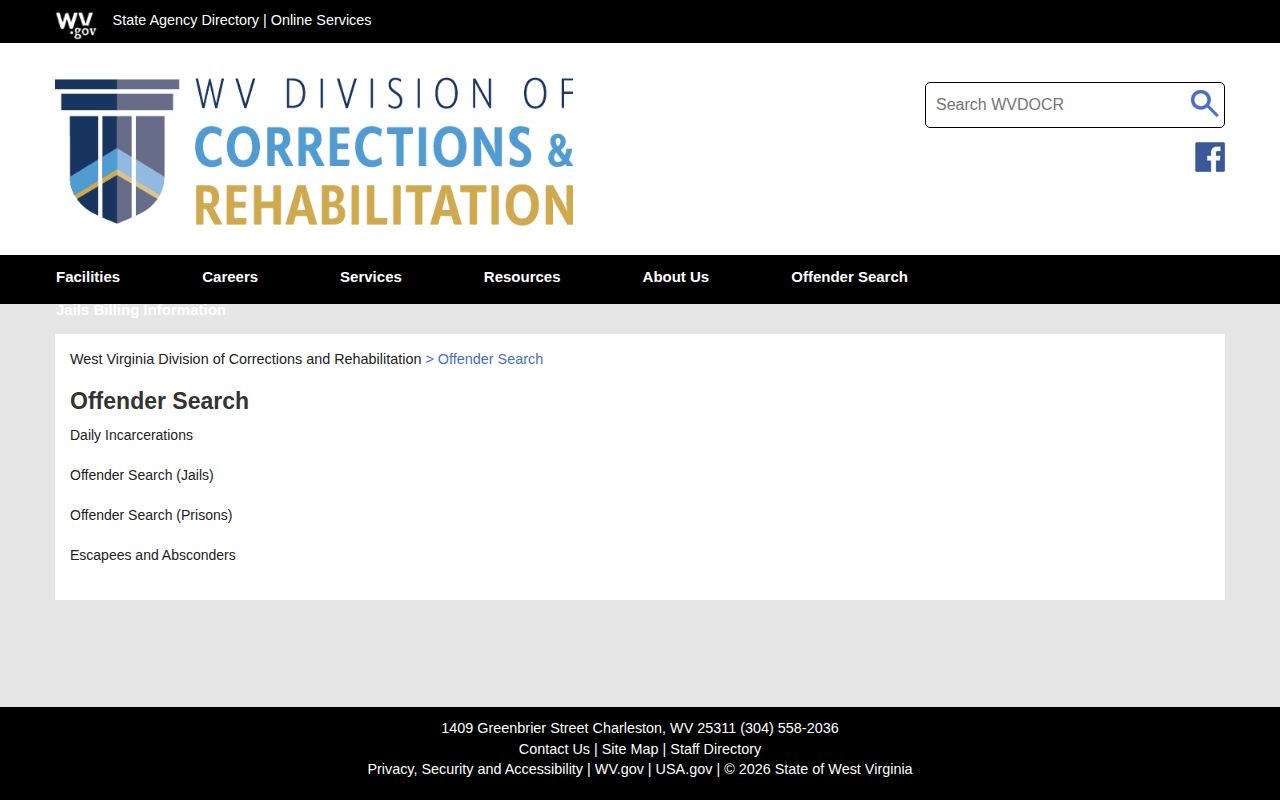
Open the tool that fits the custody status rather than treating the hub as one statewide arrest roster.
Search WVDCR by Name
Search screens can change, so start from the current WVDCR hub. The jail offender screen works from a last name. At least the first three letters are typically required. A first name is optional, with a verification step along the way. The prison route is a separate path entirely. A booking number or other identifier is not accepted. That changes only if the live form shows that field.
- Choose Daily Incarcerations for recent jail admissions, Jail Offender Search for a name-based regional-jail record, or Prison Search for a person in state-prison custody.
- Enter the last name as the live form requests. Add the first name if known, then complete any CAPTCHA or verification prompt.
- Open a possible match and compare the displayed facility, location, admission or booking date, and available identifying details. A shared name alone is not enough.
- Write down the tool name and source date. If a result shows no image or no match, ask the likely custodian; do not assume a photo was never made or that no record exists.
For a prison record, WVDCR offers its state-prison search route and the linked prison offender search app. The public page exposes only chosen fields. Spellings deserve extra care. Punctuation, aliases, and hyphens can all affect whether a name matches. The person might be in a regional jail. Go back to the jail search rather than reading an empty prison result as a release. The prison-search route tells you which WVDCR system holds a sentenced person.
This route covers prison records only. It is not a county arrest feed or a photo archive for every booking.
Fields in a WVDCR Profile
The public system shows enough to tell one custody record from another. Even so, the fields are not guaranteed on every page or for every person. Expect a name and a facility or location. A photo appears when one is on file. Admission or booking details appear too. Some records carry a "More Info" or court-order link. Details shift as WVDCR updates its site or edits a record. For a case outcome, the court file controls.
| Profile item | What it can tell you | What to verify |
|---|---|---|
| Name | The name indexed in the current tool. | Check the location and event date; a same-name result may belong to someone else. |
| Facility or location | The location associated with the displayed custody record. | Transfers may change where a person is held, and the arrest county may be elsewhere. |
| Admission or booking information | A date or event detail when the profile exposes it. | Daily data can lag or change and may not be a full arrest history. |
| Photo | An identification image, often the front image used as an OIS header when shown. | No image does not prove one was never taken; public display is not guaranteed. |
| More Info or court-order link | A path to added record context when available. | Use the court docket and clerk for later filings and certified copies. |
Date of birth, case number, bond, and charge details vary by screen and record. Treat none of them as fixed profile fields. WVDCR's own public notice warns that information may be incomplete, out of date, or wrong about a person's location, release, or status. Write down the exact label the system shows. Avoid stretching it into a broader claim.
Note: A profile is a public-system view of a corrections record, not a certified criminal-history record or final court judgment.
WVDCR Photos and Updates
WVDCR's admission policy calls for LiveScan shots at jail intake: front, left side, right side. Its offender-records policy counts three adult inmate photographs. The front image serves as the Offender Information System header. That detail explains a puzzle. An official WVDCR profile can carry an identification photo while the sheriff's public site shows no photo roster at all. The policies cover internal image handling, though. They never promise that all three views go public.
The public tool shows what it shows. It may display the front image, blank out a photo, or leave a person out of the searchable set entirely. No fixed interval governs photo updates. Nothing guarantees lasting visibility after release or discharge. Someone can drop off the live search yet linger in a historical entry, or live on as a stale copy somewhere else. A vanished search result is not proof of expungement.
Transfers and status shifts carry the same caution. A brand-new arrest may have no WVDCR admission record yet. A release or parole event can change what the search displays, and a system conversion can scramble historical material. Check the profile's date and location first. Then turn to the courts for the case result. An old photo is never a custody notice.
Close-up images of scars, marks, or tattoos get their own mention in the offender-records policy. That does not put them on the public profile. The public system may show only the front header, while other images sit in a restricted agency file. Name the exact material when you request it, and let WVDCR review it under FOIA and corrections-security rules. The WVDCR admission policy and offender-records policy describe capture and file handling, yet the public screen can still show less. Neither sets a fixed update schedule or a public retention term for any single photograph.
WVDCR Photo Versus County Photo
A county booking photo and a WVDCR offender photo often start at different desks. The sheriff or city police makes the arrest. It keeps its own booking record. Transfer to a regional jail opens the WVDCR custody record. Sentenced time brings a state-prison profile in a separate search. One system can list a person the other skips. Neither page tells the whole story.
| Record layer | When it fits | Where to verify |
|---|---|---|
| Arresting department or sheriff | Initial arrest record, local report, or agency-held booking photo. | Ask the agency's records custodian; publication practices vary by jurisdiction. |
| WVDCR jail search | Regional-jail admission or current indexed jail custody. | Use the WVDCR jail offender search and note the facility. |
| WVDCR prison search | State-prison offender profile and the photo shown with it. | Use the prison-search route for a sentenced state prisoner. |
| State court case | Charge, hearing, plea, dismissal, conviction, or later disposition. | Use the Judiciary portal and contact the circuit or magistrate clerk for certified records. |
Trace a local arrest from the ground up. Pin down the place and agency first. Then follow any transfer into WVDCR. The West Virginia County Directory points to the locality-level official source guide. Never read a state-profile photo as an arrest by the current facility.
Request WVDCR Records Under FOIA
When the search falls short, ask the custodian directly. WVDCR's FOIA request policy spells out where and how to send the agency a request. Name the facility, the person, and the time period. Add the record type and your preferred electronic format. Keep a photo request separate from a criminal-history request, because different material can carry different custodians and limits.
West Virginia Code §29B-1-3 gives a public body five days, weekends and legal holidays excluded, to produce a record, arrange inspection, or issue a written denial. Electronic copies are fair game when the record exists that way. Fees stop at actual reproduction costs. Not everything corrections holds is public. Exemptions can shield privacy, active law-enforcement matters, and operational security. The custodian decides what the law lets go.
- Use WVDCR's policy to identify the responsible custodian and current submission route.
- Name the person if known, the facility, a date range, and the precise item requested, such as the booking image or admission record.
- Ask for an electronic copy if the record exists electronically and request an itemized explanation for any fee or withheld part.
- Keep the response and any cited exemption. If the request is denied, follow the appeal or review route stated by the agency or applicable law.
The FOIA exemption text is in West Virginia Code §29B-1-4.
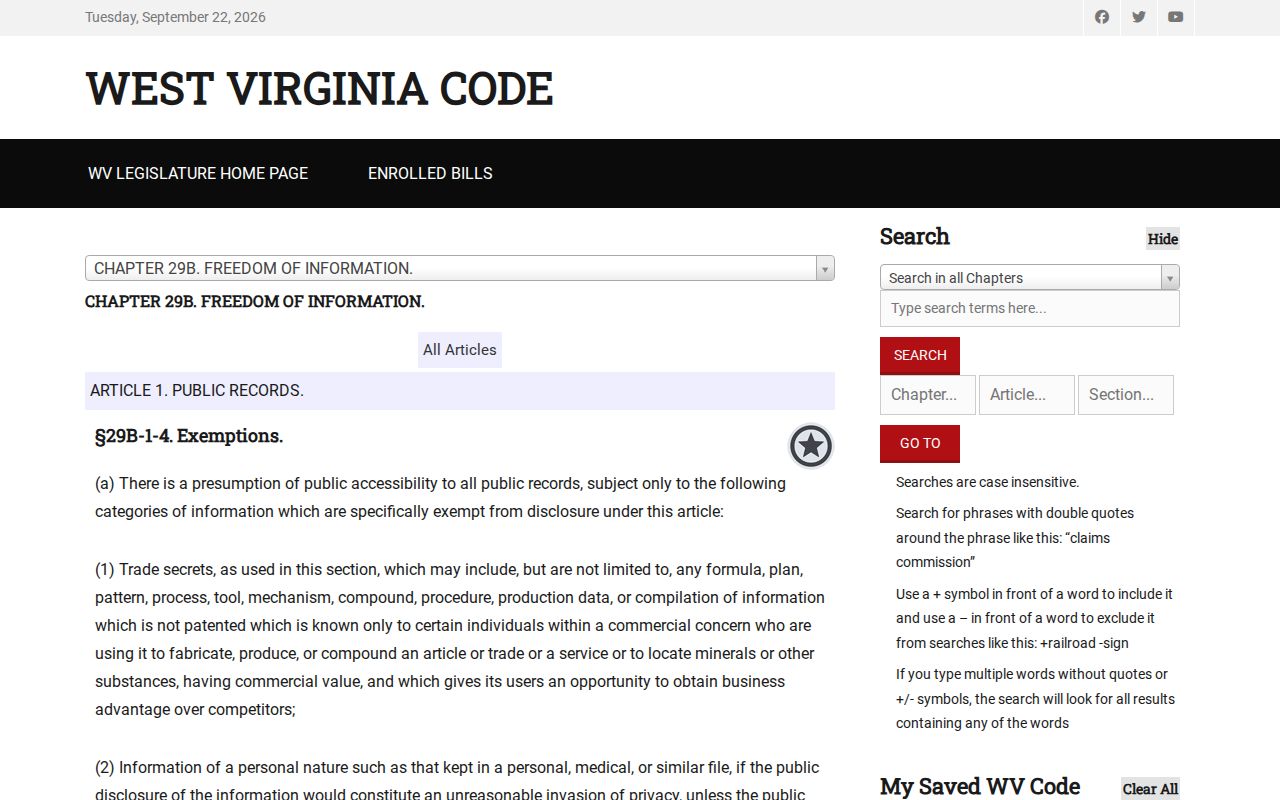
Public-record rights have edges. A request starts a custodian's review, not a release promise. The West Virginia State Records Center explains how agencies manage transfer and retention schedules for public records.

Ask WVDCR which approved series covers a given record. Ask whether the agency still holds it. The State Records Center page sets no universal WVDCR photo-retention term.
A narrow request gets the best reply. Pin the time period and the event. That could be jail admission, prison profile, transfer, release, or a specific photo. Is someone missing from the WVDCR search? The agency may never have held the original arrest report. In that case, ask the arresting sheriff or police department. The county clerk or court holds certified case documents. The statewide path is a chain of custodians, not one file room.
Note: The five-day FOIA response window is not a guarantee that a requested record will be released in full.
WVDCR Custody Notices and VINE
VINE handles notifications, not photos. WVDCR's VINE page connects you to that system. It exists for custody and release updates, nothing else. West Virginia turned the service on in December 2002. Registration runs through VINELink or the toll-free line 1-866-WV4-VINE. The alerts tell you when custody status changes, but they never deliver a booking photo or a full record.
Parole and release notices follow a separate path. Under §62-12-23d, you may need a written request to both WVDCR and the Parole Board. One registration does not cover every state record. A transfer, a release, a parole decision, and an expungement are separate events with separate custodians.
Escapee listings work differently too. An absconder entry reflects escape or supervision status. The live route shifts over time, so start at the current WVDCR hub and follow its official link. Never approach a listed person. Treat an alert as information, not an invitation to investigate in person.
Verify Court Status After WVDCR
WVDCR warns that its public information can be incomplete, delayed, or out of date, and that the court record controls the criminal action, so verify there. The Judiciary's Court Record Access page leads to circuit and magistrate indexes. Those portals show filings, hearings, pleas, dismissals, and dispositions. They are not full case files. For certified copies, the county clerk is the source.
Search the right county. Compare dates, agency, and identifiers before tying a court case to an offender profile. If the person is out of custody, the WVDCR screen may show nothing current. The docket still matters then. A records request to the agency may too. The statewide West Virginia booking-record search path explains how to move between agency, custody, court, and request sources.
Cases also hop between courts. A matter can move from magistrate to circuit court. The public index may show only an event label rather than every filed document. Read the docket sequence for later entries, since the first charge shown is not the last word. Note a dismissal, plea, or expungement order. Preserve the date and county of that disposition. It anchors any correction request to an agency or publisher, even though a corrections profile stays a custody record.
Keep the source name and date with every result. A missing WVDCR entry proves nothing about a past arrest. A stale copy is no custody notice.