
Notable West Virginia Arrest Records
The value of these cases lies in the paper trail. Not every case comes with a public mugshot. Some files sit in a county circuit court, while others live in federal court or State Archives collections. A historic portrait, a newspaper illustration, an official likeness: each keeps its own label. An image should only be called a booking photo when an official source confirms it.
So does the ending. A lookup should follow the court record all the way through, since the outcome can look nothing like the arrest notice. A person may be acquitted, plead to a narrower count, or receive a sentence the first headline never mentioned. Read the disposition beside the original charge.
A few terms help. An indictment is a formal charge. A disposition is the court's result on that charge, such as an acquittal, a guilty plea, or a sentence. Restitution is money a court orders someone to repay for a loss. The docket shows what happened next.
Presumption of innocence: an arrest or indictment is an allegation. Check the court's final disposition, including acquittals and dismissed counts, before treating a charge as an established fact.
West Virginia Cases and Dispositions
This index pairs each case with its reported outcome and its records path. Each link leads to a government, court, National Park Service, or State Archives source. Some pages explain a case without any booking image. That gap is normal for older records.
| Case | Year | Disposition | Where the record lives |
|---|---|---|---|
| John Brown, Harpers Ferry | 1859 | Found guilty and executed. | NPS case history and the Charles Town/Jefferson County proceeding; no modern booking photo. |
| William “Bill” Blizzard, treason trial | 1921–1922 | Acquitted by a Jefferson County jury. | State Archives Mine Wars records and the circuit court file. |
| Harry Powers, Quiet Dell | 1931–1932 | Convicted, sentenced to death, and executed. | Harrison County Circuit Court collection, AR1965. |
| Arch A. Moore Jr., federal corruption | 1990 | Pleaded guilty; sentenced to five years and ten months and fined $170,000. | West Virginia Supreme Court opinion and the Southern District federal docket. |
| Don Blankenship, mine-safety case | 2015–2016 | Convicted of conspiracy; acquitted on two false-statement counts; sentenced to one year and fined $250,000. | U.S. Attorney sentencing release and federal docket. |
| Allen H. Loughry II, federal case | 2018–2019 | Convicted on ten counts; sentenced to 24 months and ordered to pay restitution. | U.S. Attorney sentencing release and federal filings. |
| Menis E. Ketchum II, federal case | 2018–2019 | Pleaded guilty; sentenced to probation, a $20,000 fine, and restitution. | U.S. Attorney sentencing release and federal plea materials. |
| Rachel Shoaf, Skylar Neese case | 2013 | Pleaded guilty to second-degree murder after adult-court proceedings; later reporting identifies a 30-year sentence. | DOJ case announcement, Monongalia County Circuit Court file, and state investigation records, subject to privacy limits. |
| Derrick Evans, federal Capitol-breach case | 2021–2022 | Pleaded guilty to felony civil disorder. | DOJ plea announcement and U.S. District Court for the District of Columbia docket. |
John Brown's raid happened in 1859, when Harpers Ferry still belonged to Virginia. West Virginia did not exist yet. That line matters in a records search. The original proceeding belongs to Virginia's era, and later West Virginia Archives material adds context without replacing that court file.
Note: Court records establish case events and outcomes; they do not by themselves verify that a surviving portrait is a booking photograph.
West Virginia Historical Case Records
John Brown was seized after the October 1859 raid on Harpers Ferry. He was jailed in Charles Town. There he stood trial for murder, conspiracy, and treason. The verdict was guilty. He was sentenced to hang and executed on December 2, 1859. The National Park Service preserves the public history of the raid and the Kennedy Farm. The legal trail belongs to the 1859 Charles Town and Jefferson County proceeding. No booking photo in the modern sense existed. Any portrait or engraving keeps its own label.
William “Bill” Blizzard's record ends differently. After the 1921 mine conflict he was indicted for treason and tried in Jefferson County on a change of venue. The jury acquitted him on May 27, 1922. The West Virginia Archives' Mine Wars material and a reproduced newspaper account document that verdict. The original file sits in Jefferson County Circuit Court. It spans 1921–1923. The Archives list no booking photo. Stop at the indictment and you miss the ending. Follow the historic charge all the way to its disposition.
Harry F. Powers, also known as Cornelius O. Pierson, was arrested in Clarksburg in August 1931 during the Quiet Dell investigation. His Harrison County Circuit Court file holds the verdict, the denial of a new-trial motion, the sentence, and appeal materials. He was hanged at Moundsville on March 18, 1932. The Archives credit a period photograph to the Clarksburg-Harrison County Public Library. That image is a historic portrait or news picture, not a booking photo. The archive trail beats a copied image, because it shows which legal records survived.
The Archives' AR1965 finding aid describes the Powers court collection. No mugshot appears on it, and no face.
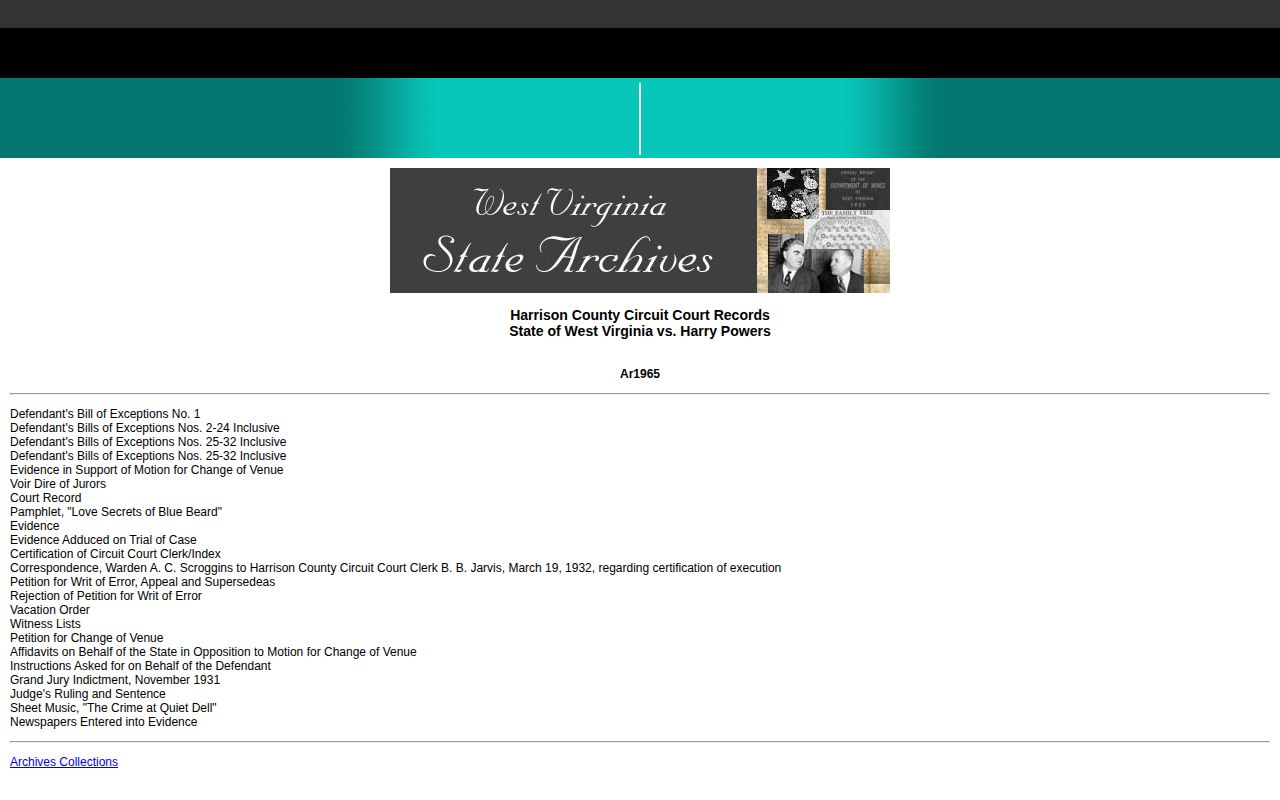
Start with the State Archives' AR1965 finding aid. An archive search runs in steps. Name the case and county, read the finding aid, then ask the custodian for the specific document or image and its access rules.
Federal West Virginia Case Records
Arch Moore Jr. spent three terms as governor. His corruption case still draws readers to West Virginia court files. In May 1990 he pleaded guilty to a five-count federal indictment. The counts covered mail fraud, Hobbs Act extortion, false tax returns, and obstruction of justice. The West Virginia Supreme Court's own opinion on the matter records a prison term of five years and ten months. A $170,000 fine came with it. That file sits with the U.S. District Court for the Southern District of West Virginia. A county jail roster will not carry it. No booking photo appears in the official record for Moore.
Don Blankenship's case grew out of the Upper Big Branch mine disaster. A federal jury convicted him of conspiring to willfully violate mine-safety standards. The same jury acquitted him on two false-statement counts. The mixed verdict is part of the case history. The U.S. Attorney's Office lists a one-year prison sentence and a $250,000 fine. His punishment appears in the prosecutor's paperwork rather than in any jail gallery. The Department of Justice sentencing release gives the final numbers. It shows no booking photo.
Allen H. Loughry II sat on the West Virginia Supreme Court when a federal indictment came down in 2018. The jury convicted him of mail fraud, seven wire-fraud counts, and two counts of lying to the FBI. He received 24 months in prison. Restitution totaled $1,273. The indictment and the verdict were separate steps in the case. The sentencing release carries the final judgment. The U.S. Attorney's sentencing announcement reports that outcome, and it supplies no booking photograph.
Menis E. Ketchum II pleaded guilty in a federal public-corruption case. The U.S. Attorney's Office set the penalty at three years of probation. A $20,000 fine came with it. Restitution was also owed to West Virginia. Anyone tracing the case should start with the plea materials and the sentencing order, since those documents form the official record path for the conviction and its terms.
The official Ketchum sentencing release spells out the full terms of the outcome. That page is the record source here. No booking photograph appears in it.
Allen Loughry's case followed a similar federal route. His release records both a sentence and restitution. That paperwork marks the difference between a verdict and a final judgment.
Derrick Evans sat in the West Virginia House of Delegates when federal prosecutors came calling. The case grew from the January 6 Capitol breach. He pleaded guilty to felony civil disorder. So where does his record trail actually live? The U.S. District Court for the District of Columbia docket holds it, along with DOJ filings. A West Virginia county booking feed is not part of that trail. Federal cases often work this way. Defendants may be processed far from home. To follow charges, a plea, a verdict, or a sentence, search the federal docket and the prosecutor's releases. County arrest systems help only when the local arresting agency made its own record. The federal file lists no public booking image. That gap is a sourcing point, not a claim that every federal defendant goes unphotographed.
Note: The federal docket is the primary path for these prosecutions, even when the person or investigation is tied to West Virginia.
Rachel Shoaf and Juvenile Privacy
The Skylar Neese case demands extra care. Rachel Shoaf was a minor at the start. Prosecution began while she was underage, and the U.S. Attorney joined the Monongalia County Prosecutor in announcing charges. They also announced an agreement to move her case into adult court. Shoaf pleaded guilty to second-degree murder. Later local reporting puts her sentence at 30 years. Juvenile privacy rules still shape this file. Court papers and state investigation materials carry limits that outlast the headlines. West Virginia law on juvenile records treats law-enforcement information about minors as confidential, with narrow exceptions. Related law on juvenile proceedings sets its own limits on what courts release. A public name does not license an old photo. An adult-court outcome grants no permission to circulate a juvenile-era picture. The DOJ case announcement documents the charging and plea facts without showing her photo. No official booking photograph is public.
Start with the Monongalia County Circuit Court record. It covers the local proceedings. The DOJ release holds the announced charging and plea facts, and juvenile material stays off limits, with no unofficial image standing in for a booking photo that was never made public.
Look Up West Virginia Arrest Records
Where do you start? It depends on where the bust happened and who holds the person. A county roster tracks recent jail intakes. A court docket shows the charges as the case moves. Old paper files sit with the State Archives, and its finding aids point the way. A famous name changes none of that. It just helps you match each question to the right custodian.
For a fresh arrest, go to the sheriff or police agency that made it. Then check the regional jail for the booking record. The statewide arrest and booking overview lays out the official search order and what to request if the online tools fall short. Know the county where the arrest took place? The County Directory connects you to the right county-level route. Older prison, court, and photograph records take more digging. Compare the collections and request steps on the Old Mugshot Archives page before you write to an archive.
Last step: confirm the case in the proper court system. State cases appear in West Virginia circuit or magistrate court indexes. Federal prosecutions belong to the federal district court that handled them. Check each charge against the final order or the docket entry itself. If no original booking photo exists in the record, rely on the written file. A portrait from an unrelated source proves nothing.
Note: A public case summary can help locate the docket, but the court or agency record controls the documented charge and disposition.